UTILITIES
Modernizing Utility Connectivity
for a More Reliable, Resilient Grid

Electric utilities are facing growing pressure to modernize aging grid infrastructure while maintaining reliability, regulatory compliance, and operational control. Grid modernization initiatives are rapidly increasing connected devices, automation, and data volumes across generation, transmission, distribution, and the grid edge—placing significant strain on legacy utility communications networks. At the same time, utilities must support electrification, DER integration, AI-driven analytics, and large data center interconnections without compromising resiliency, cybersecurity, or safety.
The challenge is no longer access to technology, but how to sequence, integrate, and scale utility-controlled connectivity in alignment with operational priorities and regulatory requirements. Fragmented pilots, overlapping network initiatives, and siloed decision-making increase risk and slow the transition from experimentation to production.
Future Technologies partners with electric utilities as a trusted advisor and orchestrator, helping them move from fragmented communications environments to unified, utility-controlled connectivity architectures. Through advisory-led engagement, Living Lab validation, and phased deployment models—delivered in partnership with GE Vernova and a trusted ecosystem—we enable utilities to modernize grid communications with confidence, improving reliability, resiliency, and cybersecurity readiness for next-generation grid operations.
Electric Utilities

Water Utilities
“We need a multi-layer network strategy leveraging fiber, cellular and satellite that gives us redundancy and self-healing built on top of a unifying software fabric for managing the hundreds of sites…”
- Director of IT Telecommunications, Large Investor-Owned Utility , UBBA Plugfest
The business case for Connectivity Transformation
Managing Sequencing Risk as Grid Digitization Accelerates
Electric utilities are deploying sensors, automation, advanced protection and service restoration, and digital applications faster than legacy communication network architectures can support. The primary risk is no longer technology selection, but misaligned sequencing where pilots advance without a scalable architecture, and network ownership becomes fragmented across departments and vendor platforms.
Connectivity transformation, led through advisory-driven orchestration, allows utilities to align network evolution with operational priorities before expanding private cellular or other broadband technologies. Our approach ensures that electric utility deployments reinforce a long-term, adaptable architecture that scales with evolving grid transformation initiatives.
Establishing a Unified, Utility-Controlled Communications Foundation
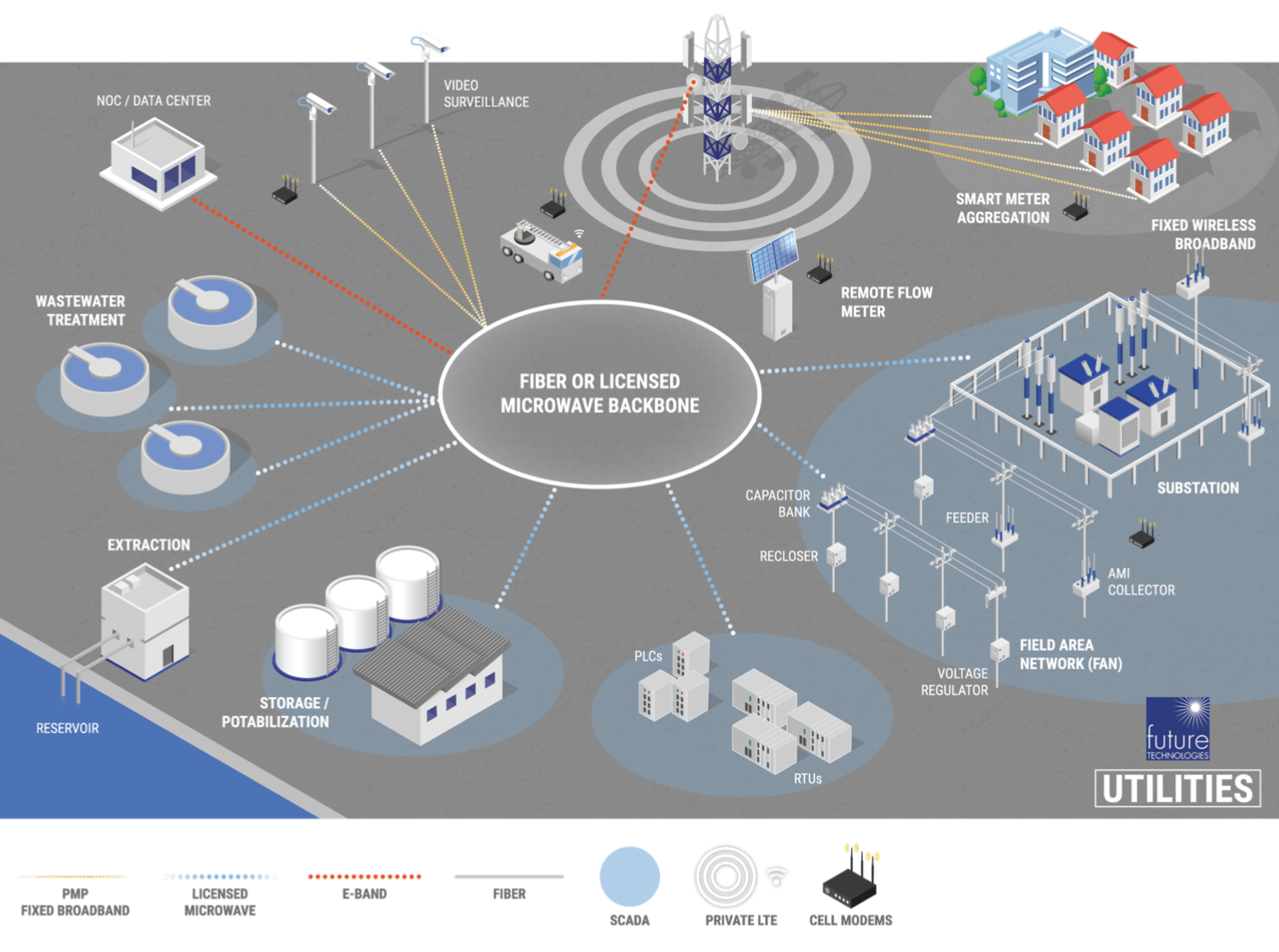
No single network can meet the full range of grid connectivity requirements. A modern utility architecture can integrate fiber, microwave, private and public cellular, and satellite as coordinated layers within a unified operational framework.
Private cellular plays a critical role where utilities require deterministic performance, resilience, and local control, particularly in support of advanced metering, automation, protection, and distributed grid-edge intelligence. When deployed in a coordinated maner, it complements existing network infrastructure, rather than displacing them, which strengthens operational control while simplifying lifecycle management.
Reducing Operational and Organizational Friction While Modernizing
Connectivity decisions span OT, IT, engineering, operations, cybersecurity, procurement and executive leadership, each with different mandates and risk tolerances. Without a structured approach, this complexity slows decision-making and increases regulatory exposure.
Our phased, de-risked approach allows utilities to validate use cases, align stakeholders, and demonstrate outcomes incrementally. This builds confidence, supports regulatory defensibility, and enables modernization without impacting operational stability.
Our Trusted Partners
GE VERNOVA
GE Vernova’s Grid Solutions portfolio serves as the OEM foundation for Future Technologies’ utility offerings, delivering utility-grade networking, private cellular, and grid digitalization solutions designed for mission-critical operations.
Purpose-built for electric utility operations, GE Vernova Grid Solutions integrates resilient communications, scalable core functionality, secure edge and network management, and deep alignment with grid systems such as SCADA, ADMS and DERMS. Combined with Future Technologies’ advisory-led orchestration and deployment expertise, our partnership enables utilities to modernize connectivity with reduced risk, simplified lifecycle management, multi-vendor interoperability, and long-term architectural adaptability.
Common Use Cases Enabled by Private Networks
As utilities expand automation across feeders, substations, and field devices, communications networks must perform under fault, outage and adverse grid conditions. Private cellular provides deterministic latency, high availability, and secure device identity and traffic to support protection, control, and automation workflows. This enables faster fault isolation, remote switching, coordinated restoration, and safer field operations, while preserving utility ownership and operational control of the network.
Operational Benefit: Improved SAIDI/SAIFI performance, reduced truck rolls, and safer, faster outage response.
Utilities are rapidly deploying sensors, drones, cameras, weather stations, and AI-enabled monitoring at the grid edge to address vegetation management, wildfire risk, extreme weather, and monitor asset health. These deployments generate large data volumes, often in rural or high-risk service areas where network coverage is inconsistent. Private cellular provides scalable uplink (and downlink) bandwidth, consistent security capabilities, and reliable backhaul for real-time and near-real time grid-edge data, image and video transfer. This enables early event detection, AI-assisted analytics, and improved situational awareness during normal and emergency operations.
Operational Benefit: Early risk detection, improved storm and wildfire response, and more proactive asset management.
As DERs, microgrids, flexible loads and edge compute platforms proliferate across transmission, distribution and grid-edge locations, utilities must securely coordinate assets operating beyond traditional network boundaries. Private cellular enables segmented, policy-controlled connectivity that supports secure device onboarding, data federation, and real-time coordination. This architecture integrates DER assets with substations and control centers while supporting interoperability with ADMS, DERMS, and SCADA, laying the foundation for advanced grid optimization and AI-driven operations.
Operational Benefit: Scalable DER integration, stronger cybersecurity posture, and readiness for next-generation grid control and AI-driven analytics.
LET'S CONNECT
Schedule a 30-min discovery call with our team where we walk you through a virtual tour of our Living Lab, showcasing how private networks are enabling our clients’ Edge and AI Solutions with real-life use cases & business outcomes.
WHO WE ARE | Future Technologies Venture, LLC (“Future Technologies”) is a North American lead systems integrator specializing in end-to-end private network solutions for Manufacturing, Energy, Transportation, Military, and Government sectors. Founded in 1999 and headquartered in metro Atlanta, GA, the company delivers assessment, design, deployment, and ongoing support to enable mission-critical infrastructure solutions. With expertise spanning Private 5G, Fixed Wireless, Wi-Fi, Fiber, and legacy networks, Future Technologies powers advanced connectivity solutions—from AI, Edge Computing, and Robotics to Connected Worker and Automation.