Cognitive Connectivity for Contested Logistics

Cognitive Connectivity for Contested Logistics
Tomorrow's missions demand more than just faster networks. They require connectivity that thinks, adapts, and acts at the edge with the warfighter.
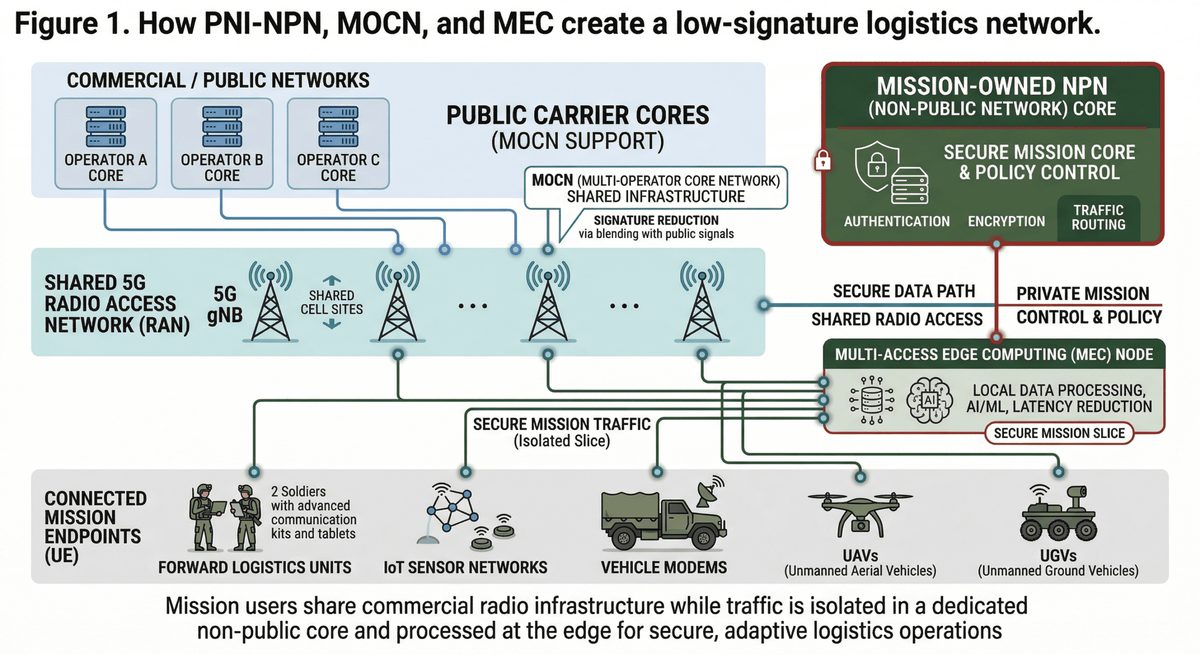
At Future Technologies, we are laying the foundation now by integrating Public Network Integrated-Non-Public Network (PNI-NPN), Multi-Operator Core Network (MOCN), and multi-access edge computing (MEC) to change how forward units maintain operations in contested environments.
The goal is clear: equip non-standard logistics providers with the agility of commercial networks, the security of mission networks, and the survivability needed when the electromagnetic spectrum becomes a battlefield.
Built on operational scale, not theory
Future Technologies brings real, measurable experience to this challenge. We have designed, deployed, and maintained private cellular networks covering over 4,000 square miles across mission-critical industrial and defense settings. This includes both standalone private systems and architectures integrated with public network infrastructure, providing us with practical insight into how to combine commercial and non-public networks without compromising control or security.
We are also certified to design and integrate systems for major mobile network operators and have built a strong ecosystem with industry leaders like Nokia, Ericsson, and Dell. For customers, this means lower integration risk, faster deployment, and architectures aligned with operator and OEM best practices from the start.
Why PNI-NPN and MOCN matter
PNI-NPN shifts the approach by enabling a private cellular capability within a public mobile network rather than operating separately. Mission traffic stays isolated, encrypted, and policy-controlled, while the air interface appears and functions like regular commercial traffic. In contested environments, this is critical. Standing out electronically can be as risky as losing connectivity entirely.
MOCN enhances that advantage. A single radio access network serves multiple operators and multiple cores simultaneously. In practice, this means the same 5G RAN supports public users while directing mission users into a dedicated non-public core and slice. Logistics users and sensors move through an area using the same cell sites as civilians without compromising mission ownership of policy, identity, or protection.
That combination provides three operational advantages:
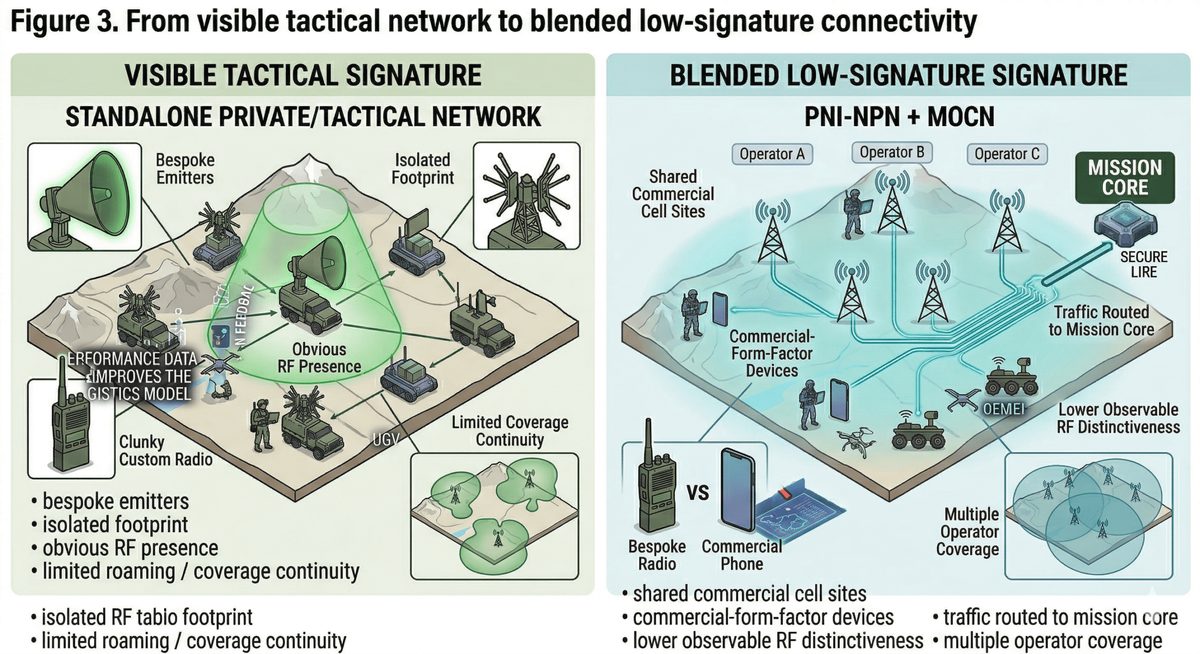
- It decreases reliance on custom, high-power tactical emitters that are easier to detect.
- It makes signaling behavior more difficult to tell apart from normal commercial activity.
- It enables access to multiple operator footprints while maintaining a consistent, encrypted mission environment.
In short, PNI-NPN and MOCN help logistics traffic blend into the background rather than stand out.
A lower-signature network for non-standard logistics
Non-standard logistics relies on flexibility: local partners, irregular routes, commercial conveyances, and distributed sustainment nodes. The supporting network must be equally adaptable.
With PNI-NPN integrated into public infrastructure, user devices adopt commercial form factors like smartphones, tablets, vehicle modems, and IoT tags that do not immediately indicate a tactical presence. Simultaneously, policy enforcement within the core network keeps mission traffic segmented, encrypted, and access-controlled. Dynamic adjustment of power, cell selection, and handovers further minimizes persistent RF patterns that serve as targeting cues.
The result is a logistics network that stays connected and data-rich, yet is much harder to isolate, classify, or target based on communications alone.
MEC transforms connectivity into a decision advantage.
If PNI-NPN and MOCN reduce signature, MEC provides the network intelligence.
Contested logistics cannot rely on fixed depots, predictable routes, or constant reachback. Decisions must be made near the point of need. MEC places computing at the edge at forward hubs, aboard ships, inside hardened shelters, or on transportable nodes so logistics decisions occur where the data is generated and where time is most critical.
That changes the operating model.
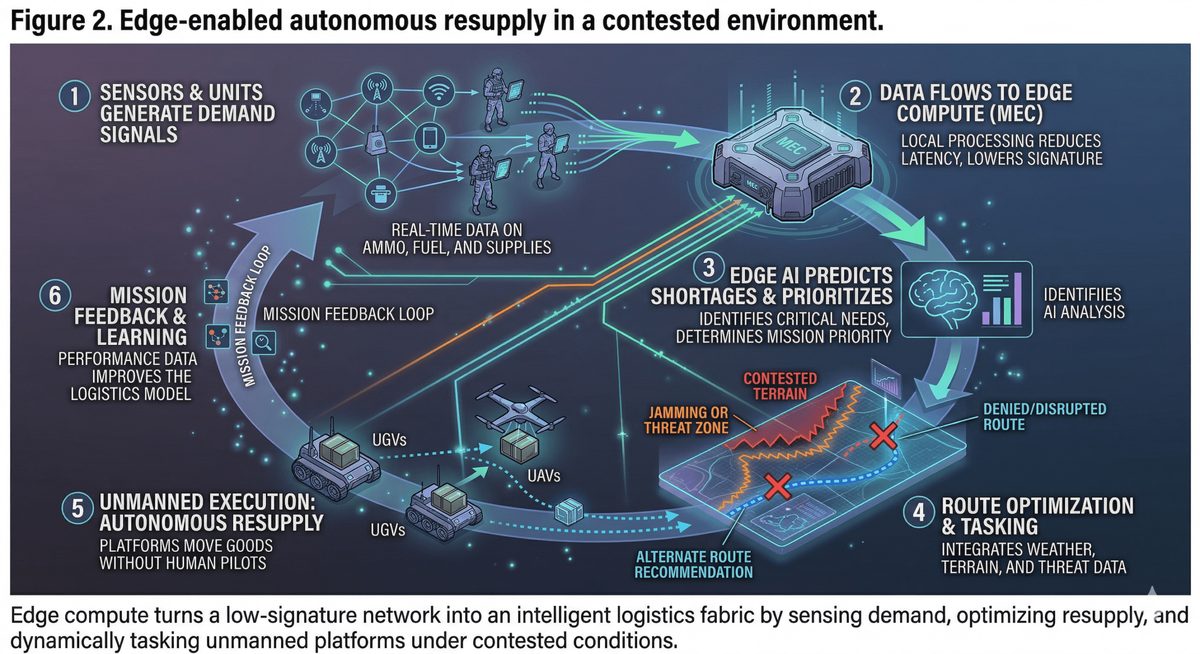
Edge applications gather telemetry from vehicles, weapons systems, generators, medical supplies, and environmental sensors to provide a near-real-time view of readiness and demand. Local analytics forecast stock shortages, prioritize resupply efforts, and determine the best delivery times. Unmanned ground and aerial platforms receive updated missions at the edge, rerouting around terrain, weather, jamming, or threats as conditions evolve.
As missions are completed, the system gets better. Feedback loops fine-tune the models, boosting accuracy and efficiency over time. Since this orchestration runs on the same PNI-NPN/MOCN-enabled fabric, the autonomous resupply chain gains from both improved intelligence and lower observability.
The logistics network is becoming smarter, faster, and more difficult to detect.
From architecture to sustainment
What makes this relevant to defense programs is not just the architecture but also the ability to design, field, and maintain it at scale.
Future Technologies designs PNI-NPN and MOCN solutions utilizing existing public infrastructure while satisfying mission assurance and security needs. We deploy and improve MEC platforms to support AI and logistics workloads at the edge. Additionally, we operate and sustain these systems over time, ensuring performance, cyber hygiene, and ongoing enhancements throughout the program's lifespan.
For DoD customers and prime contractors, that means working with a partner that understands both the technical architecture and the operational realities of fielding it in demanding environments.
The next battlespace will reward networks that think
The convergence of PNI-NPN, MOCN, and MEC creates a new design space for contested logistics. It allows sustainment networks to operate within commercial environments, utilize commercial infrastructure, support autonomous platforms, and still maintain mission control, encryption, policy, and survivability.
That is what cognitive connectivity looks like in practice: a logistics network that integrates seamlessly, operates at the edge, and maintains supply under pressure.
For defense organizations and industry partners shaping the next generation of resilient, low-signature, AI-enabled logistics solutions, Future Technologies is prepared to assist in designing, deploying, and maintaining that future.
For More information, reach out to: sales@futuretechllc.com